
Logan County Court Records After Arrest
Court records after a jail arrest in Logan County begin with a simple sequence: arrest, booking, first appearance, DA filing, and then the court record. The county's booking notice says the person is first told the charge by the arresting officer, deputy, or intake deputy. That charge is confirmed at the first court hearing, which is typically the first working day after intake. The Logan County Combined Courts page gives the local court route for docket search, records request, and in-custody advisements.
The booking side and the court side must be kept separate. Custody, jail mail, bond payment, and current jail status belong with Logan County jail inmate records. Booking photos and photo requests belong with Logan County jail mugshots. The court record after arrest is the formal criminal case: filed charges, case number, hearings, bond orders, plea settings, dismissals, amendments, and disposition.
Arrest to Logan County Court Record
The local pathway is strongest when read from jail, court, and prosecutor sources together. The jail creates the booking record and handles custody. Logan County Combined Courts handles advisements, bond hearings, dockets, record requests, and case events. The 13th Judicial District Attorney decides which charges to file after reviewing reports from law enforcement.
Arrest -> booking -> first appearance -> DA filing -> court record. That flow explains why the same case can have more than one charge label. The booking charge may be an intake label. The filed charge is selected by the prosecutor. Later court events can amend, reduce, dismiss, or resolve that charge.
| Stage | Record Source | What to Check |
|---|---|---|
| Arrest and booking | Jail and sheriff records | Initial charge, custody status, bond status, booking documentation. |
| First appearance | Logan County Combined Courts | Advisement, bond hearing, next court date, public defender route. |
| Prosecutor review | 13th Judicial District Attorney | Filing decision, charge selection, victim services information. |
| Court case | Court docket and records request | Filed charges, case number, hearing dates, disposition. |
Find Logan County Court Records After Arrest
The court page links to docket search and records request tools rather than publishing a full field-by-field criminal case form in the page text. A good court search starts with the defendant's full name, date of birth when available, the arrest date, and any case number from bond paperwork or court notices. If the arrest just occurred, wait for the first advisement or bond hearing context because a case may not be visible before the court receives and processes it.
- Start with booking facts from the jail or arresting agency so the name, date, and custody route are clear.
- Use the Logan County Judicial Branch page to reach Find Dockets or the records request link.
- Search by defendant name or case number. A case number is better when available because common names can produce false matches.
- Open or request the case record and compare the charge list to the jail intake charge.
- Check bond paperwork, upcoming court dates, and disposition entries before treating a charge as final.
For statewide Colorado criminal history, the CBI Internet Criminal History Check is a separate name-based CHRI route. CBI notes that public results have exceptions, including juvenile arrests, traffic arrests under age 16, and sealed arrests. CBI records also depend on disposition updates from courts and agencies.
Logan County Court Request Fields
The court records request workflow should be described as request details, not as a guaranteed public search form. The Judicial Branch page says the clerk contacts the requester by email or phone after a request is received and reviewed. That review step is important because certified copies, older records, or detailed criminal filings may need clerk handling.
| Field Label | Type | Required | Options / Format Notes |
|---|---|---|---|
| Defendant / party name | Text | Likely | Used to identify the case when no case number is known. |
| Case number | Text | Helpful if known | Best way to avoid name-match errors. |
| County | Selector or link context | Yes | Use Logan County in the 13th Judicial District. |
| Record requested | Text | Yes for records request | Docket, complaint, register of actions, disposition, copies, or certified records. |
| Contact email / phone | Text | Yes | The clerk uses this to follow up after review. |
Logan County Court and DA
The Logan County Combined Courts office is at 110 N Riverview Road, Room 205, Sterling, CO 80751. Its page lists docket search, records request, online payments, public defender instructions, virtual courtroom access, ADA accommodations, interpreter requests, transcript requests, and advisement or bond hearing links. The advisement and bond hearing detail is specifically for people held on Logan County cases.
The 13th Judicial District Attorney page names District Attorney Travis Sides and explains that the DA represents the People of the State of Colorado in criminal court. The DA serves Logan, Morgan, Phillips, Washington, Sedgwick, Yuma, and Kit Carson counties. A deputy district attorney reviews law enforcement reports and decides what charges are appropriate under current law.
The Logan County Combined Courts source page is the screenshot source for the local court-records route, including docket and records request links.
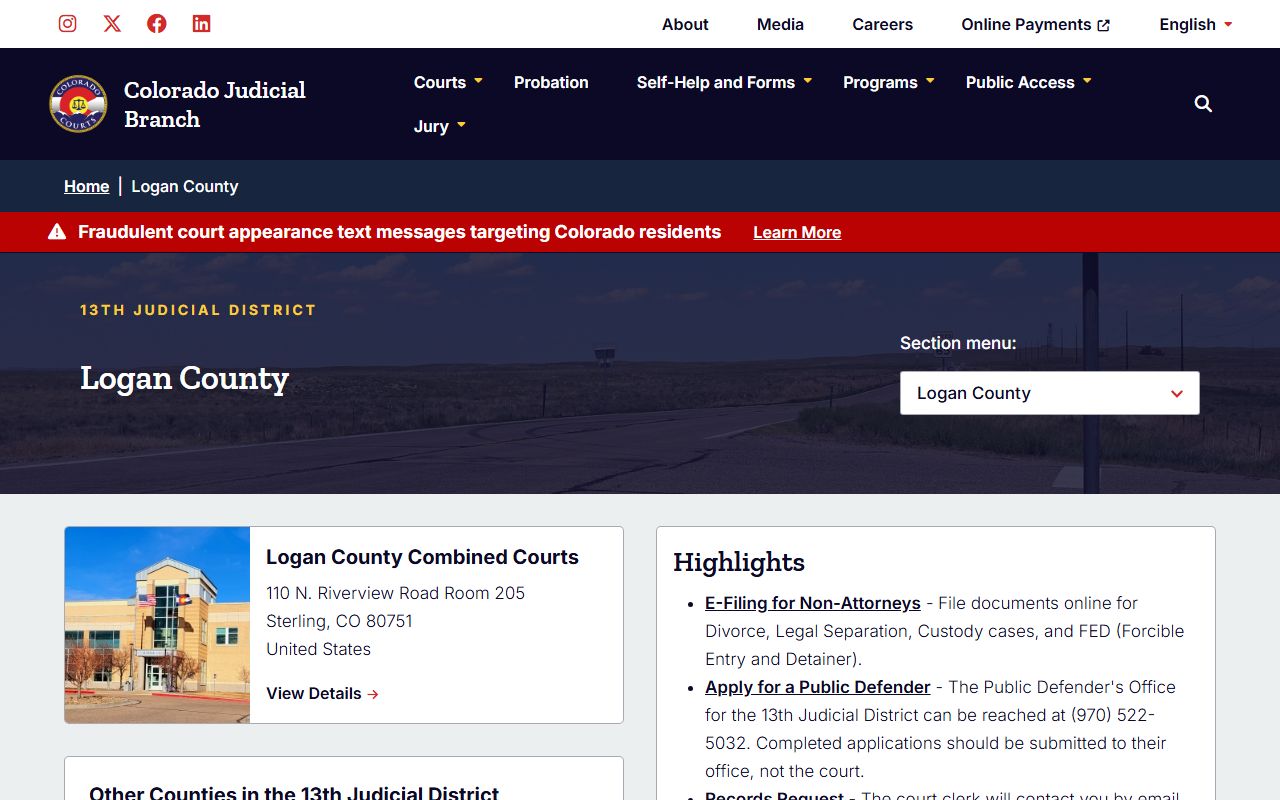
The court page is the local source for finding the filed case, while the DA page explains why a booking label may change once a prosecutor reviews the file.
Logan County Charging Documents
A court record after arrest usually turns on the charging document. The filing document tells the court what the prosecutor or grand jury is asking the court to hear. It should not be confused with the jail booking line. A booking line can be useful for early custody calls, but the charging document is what anchors the court case.
| Document | Filed By | Common Use | Why It Matters |
|---|---|---|---|
| Complaint | Officer or prosecutor | Often starts criminal charges after arrest. | May be the first formal court charge record. |
| Information | Prosecutor | Common in felony prosecution after applicable procedure. | Shows prosecutor-selected charges. |
| Indictment | Grand jury | Less common in routine local cases. | Starts charges through grand-jury action. |
Logan County Charge Status
Charge status changes as a case moves. A pending charge is active. An amended charge has changed language, count, level, or statute reference. A reduced charge is usually lowered through amendment or plea. A dismissed charge ends without a conviction on that count. Disposition means the final outcome of a charge, and CBI uses disposition updates to complete criminal history records.
| Status | Meaning | Record Caution |
|---|---|---|
| Pending | The charge is active and unresolved. | It is not a conviction. |
| Amended | Charge language, level, or count changed. | Compare older docket entries to newer orders. |
| Reduced | The charge was lowered by plea or amendment. | The final disposition controls the outcome. |
| Dismissed | The charge ended without conviction on that count. | Sealing rules may still require a separate process. |
| Disposition entered | A final outcome has been recorded. | Use official court records when correcting CHRI. |
Bond After Logan County Arrest
Bond and advisement hearings for people held on Logan County cases are listed at 2:15 p.m. daily. Logan County's bond notice lists property, cash, surety or professional, personal recognizance, PR co-signer, and no-bond status. A no-bond hold is a court decision. A detainer is a hold or notice from another agency that may affect release even when the local bond issue has been addressed.
| Bond Type | How It Works |
|---|---|
| Cash bond | The full amount is paid in cash and returned by the court when required appearances are complete. |
| Surety bond | A licensed bondsman posts bond and usually charges a fee, with possible collateral or co-signer terms. |
| Personal recognizance | The judge releases the person on a promise to appear. |
| PR co-signer | A judge allows another person to sign for release and accept appearance responsibility. |
| No-bond hold | The court has not authorized release on bond at that stage. |
Charges vs Convictions
An arrest and a filed charge are not the same as guilt. The DA may file a charge after reviewing the police report, but the case still has to move through court. A conviction requires a guilty plea, verdict, or other final finding. This distinction is central when reading court records after a jail arrest because early dockets can show accusations that later change or end.
| Charge | Conviction | |
|---|---|---|
| Stage | Accusation filed in court. | Final guilty plea, verdict, or finding. |
| Proof level | Based on filing standards and probable cause context. | Requires the criminal case to be resolved as guilt. |
| Can change | Can be amended, reduced, or dismissed. | Can still be appealed or subject to later relief, but it is a final case outcome. |
Sealed vs Expunged Records
Colorado record access is shaped by the Colorado Criminal Justice Records Act, court rules, and specific sealing or juvenile protections. Public access does not mean every court or arrest record stays visible to every requester. Juvenile records, sealed cases, sexual-assault victim identifiers, and some investigative material can be restricted or redacted.
| Sealed | Expunged | |
|---|---|---|
| Public view | Hidden from ordinary public access. | Treated more like removal from normal record access, where eligible. |
| Agency access | Some agencies may retain limited access under law. | Access is more limited and depends on the record type. |
| Common context | Dismissed, eligible, or resolved cases under Colorado sealing rules. | Often associated with juvenile or specific statutory relief. |
| Best source | Court order and clerk record. | Court order and statute-specific process. |
Important: Public case lookup is not an FCRA consumer report and should not be used for employment, credit, tenant, insurance, or similar screening.
Restricted Logan County Court Records
Some court records after a jail arrest may be limited even when the underlying event is real. Colorado law defines criminal justice records and official action records, but custodians still apply statutory limits. Sexual-assault victim identifying information can be deleted before release. Juvenile material, sealed arrests, and active investigative details may not be public. A court request can also take review time because the clerk may need to confirm the record, fees, copy format, and release limits.
Warrants follow the same caution. No official Logan County sheriff active-warrant search or most-wanted list was located on the Colorado county site. Bench warrants and case warrants are more likely to be confirmed through court records, the docket, the sheriff, or an attorney. A warrant arrest may lead to Logan County Detention Center booking, but the warrant record is still a separate court or agency matter.